History and heritage of the Saint-Pierre-Ville church
The history of the Saint-Pierre-Ville church cannot be separated from that of Saint-Pierre-des-Corps, nor from that of Tours. Indeed, on the eve of the Revolution the situation was rather unusual: dedicated as the church of Saint-Pierre-des-Corps, it stood inside the 17th-century walls of Tours, while the parish attached to it lay “outside the walls”.
After the creation of the commune of Saint-Pierre-des-Corps (1793) and the transfer to the City of Tours (1855) of a strip of land reaching eastwards as far as today’s Quai de la Gare du Canal and taking in the La Fuye district to the south, things became clearer. But it was not until 1906 that the parish was truly attached to Tours... The church’s name was changed for good: from “Saint-Pierre-des-Corps” it became “Saint-Pierre-Ville”.
Probably one of the earliest churches in Touraine (4th and 5th centuries), mentioned and therefore attested in a 9th-century charter, and known in the 12th century to have had much the same proportions as today, the church was rebuilt in the 14th century and altered during the 15th and 16th centuries. Reworked once again by Gustave Guérin, the city, county and diocesan architect and a champion of the Gothic Revival, it only took on its present appearance from 1965 onwards: walls and façades entirely rendered and stripped of all ornament, windows on the north side partly replaced, and even the bell tower rebuilt, this time in wood.
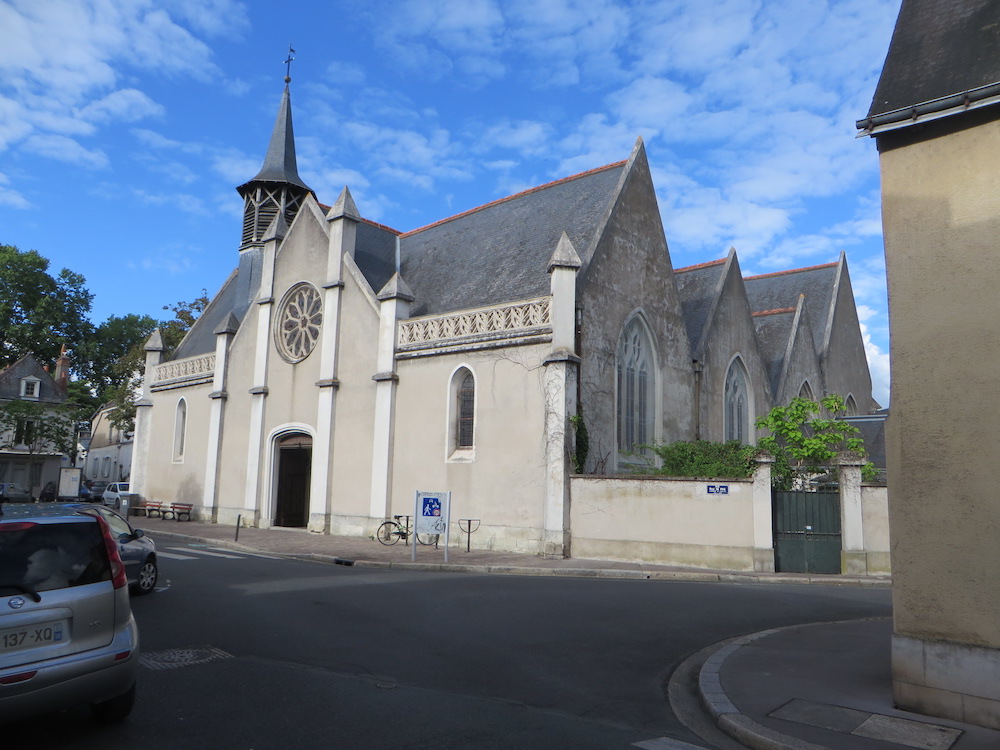
Inside, the nave is filled with painted plaster statues. On the north side they depict the Archangel Raphael, Saint Peter and Saint Joachim; on the south side, Saint Michael, the Virgin Mary and Saint John at the foot of the Cross, and Saint Anne with the Virgin Mary. Note that Saint Michael has pride of place, right by the entrance. Today it can be seen as a nod to the chapel of the same name, close by, and to the presence of the Ursulines, who continue to watch over not only the church but also the neighbourhood.
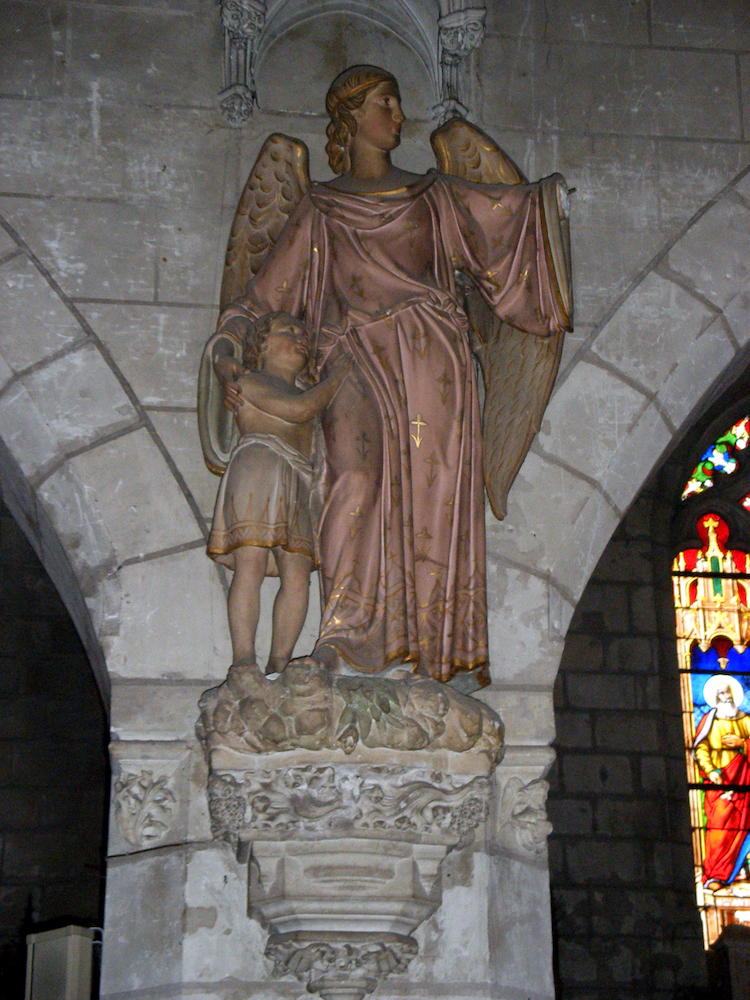 Archangel Raphael
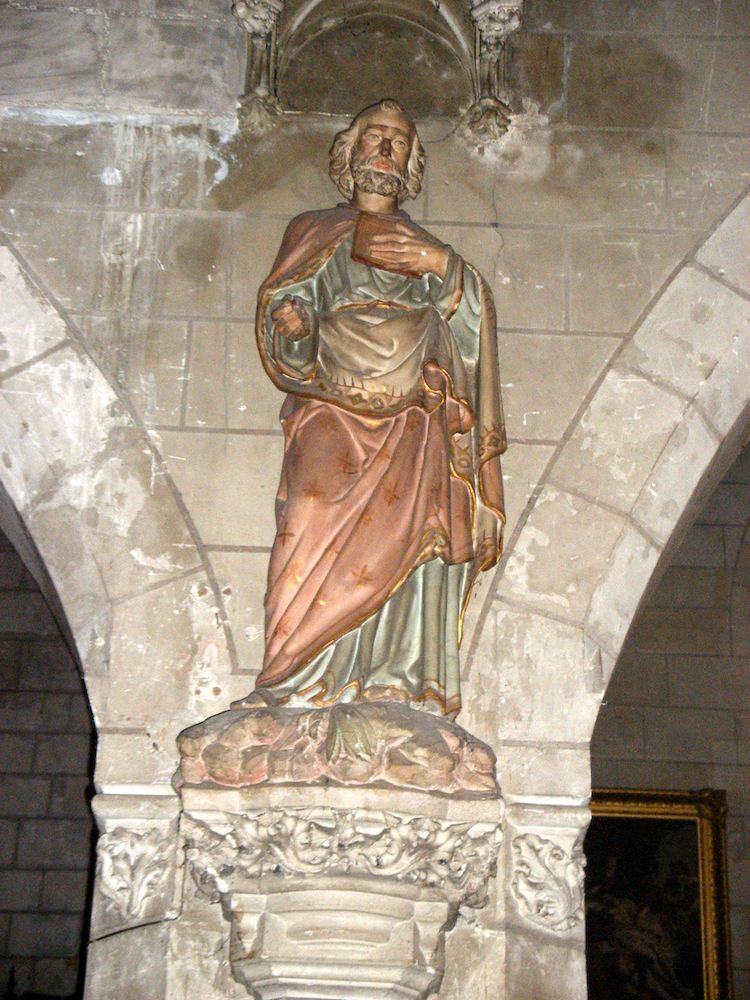 Saint Peter
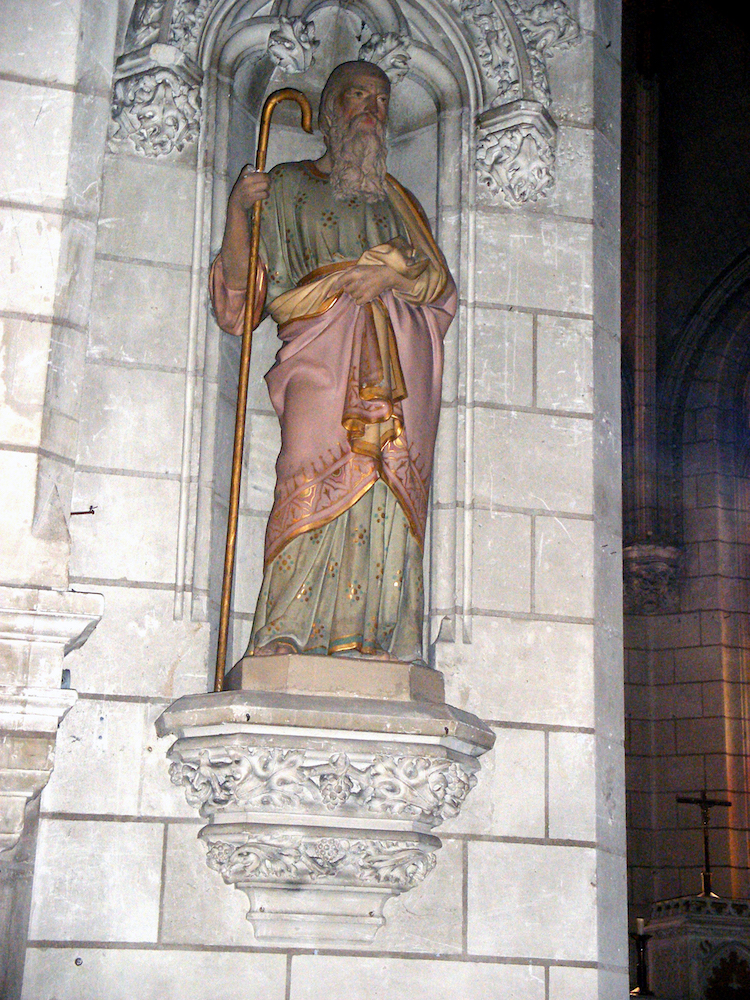 Saint Joachim
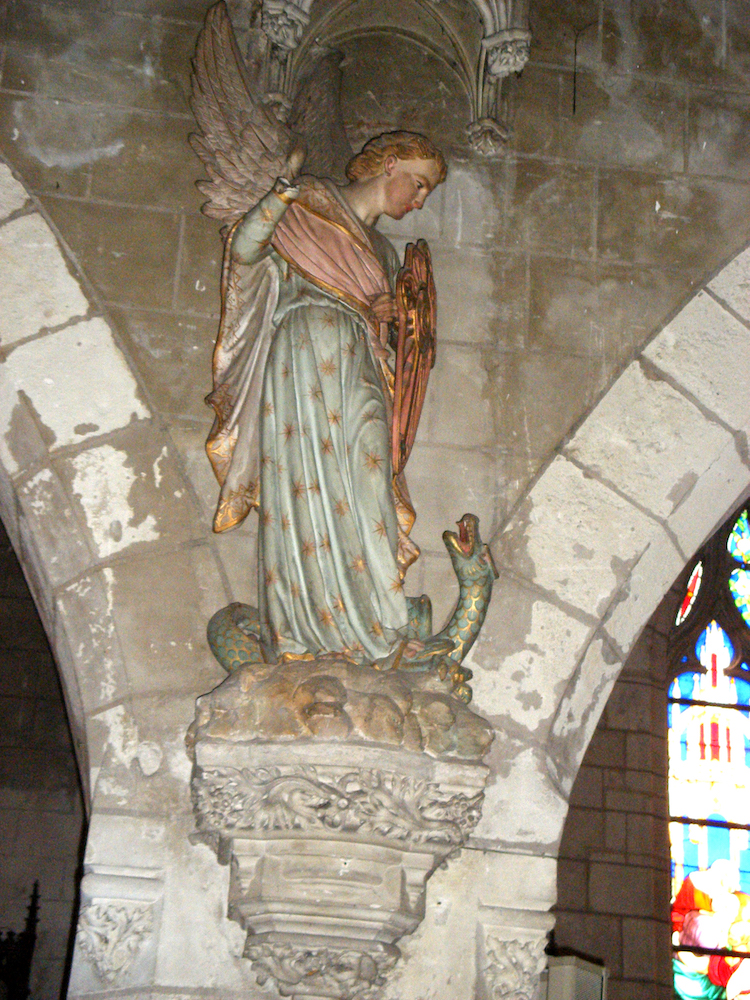 Saint Michael
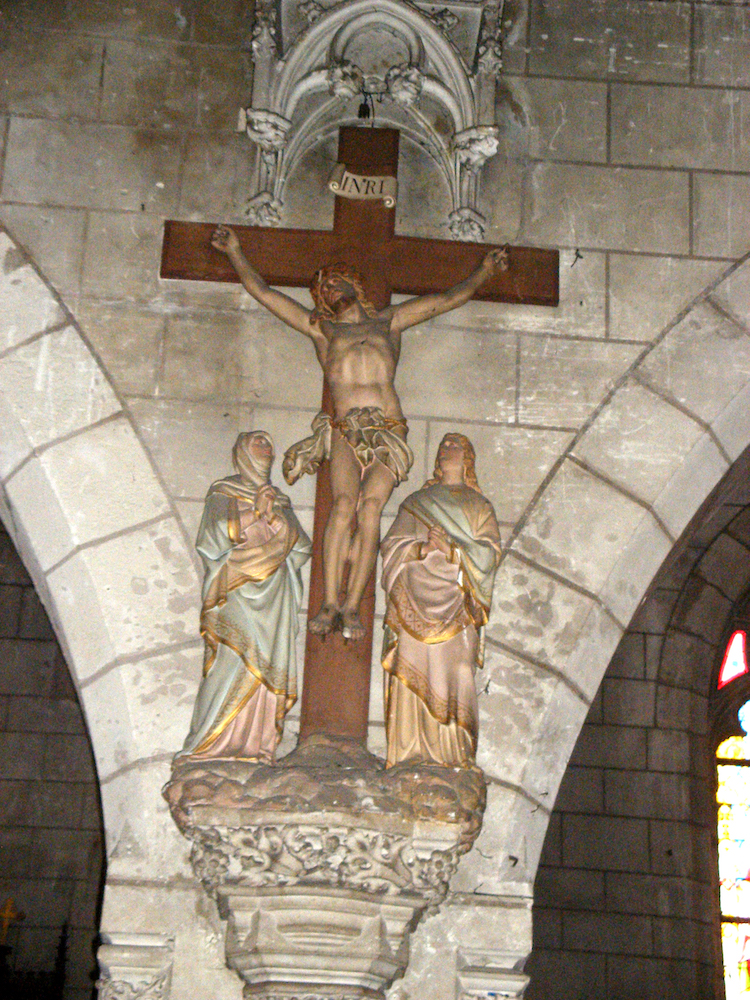 The Virgin Mary and Saint John
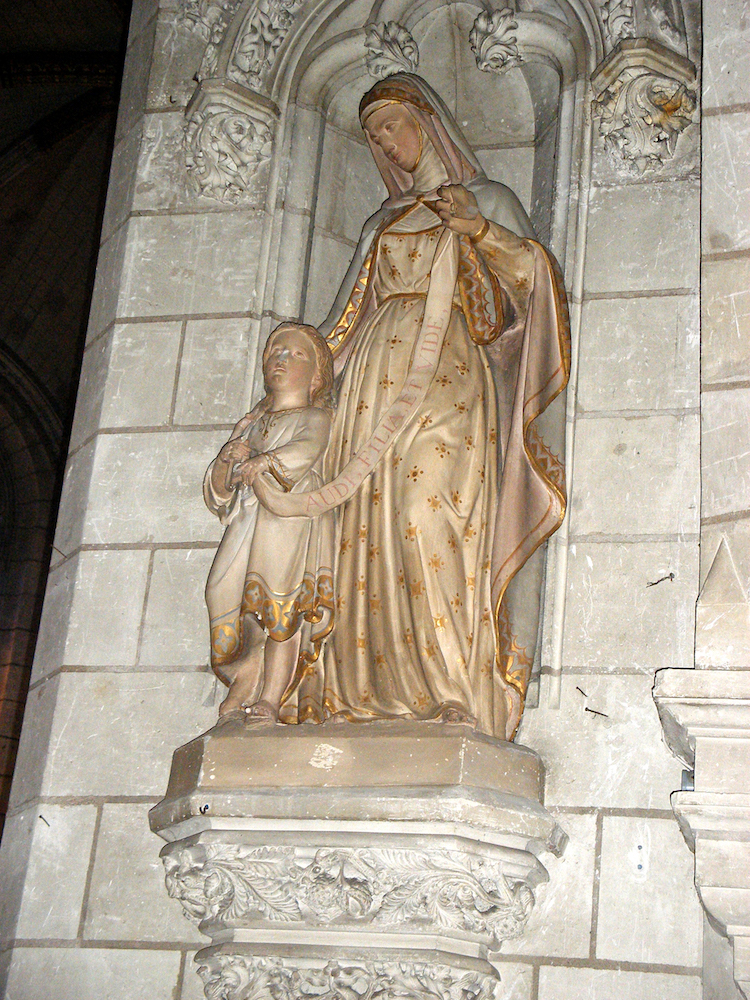 Saint Anne and the Virgin Mary
A visit to the Saint-Michel chapel on rue des Ursulines is a must, to discover the history of the congregation’s former convent and of Saint Marie de l’Incarnation, a model for the Church and the woman from Touraine who evangelised the Iroquois in the 17th century.
All this conveys the family atmosphere that strikes you as soon as you enter the church: the everyday life of believers, earthly and spiritual life, simply evoked. This intimacy is heightened by the 19th-century false plaster vaults, which replaced the original panelled vault and so changed the proportions: we are not far from those of a home.
Following the usual layout of 19th-century churches, each of the two aisles ends in an altar: one dedicated to Saint Joseph, the other to the Virgin Mary at the end of the south aisle. Behind the altar dedicated to Mary, a fresco by Paulette Richon painted in 1941 depicts various places where the Virgin appeared, as well as the particular virtues on which the devotion of the faithful rests.
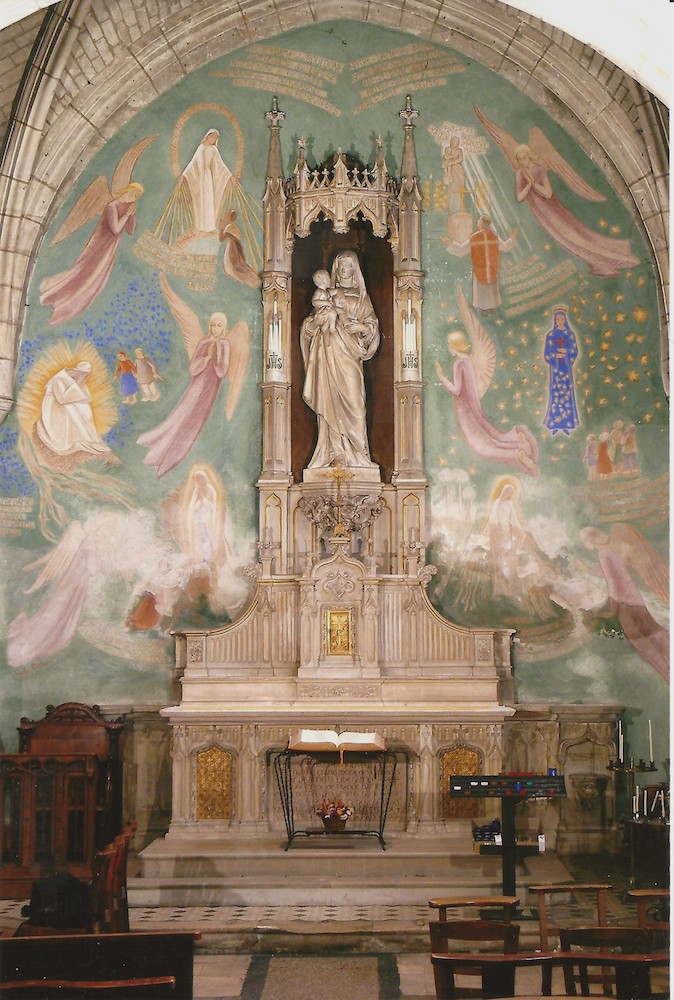 Fresco by Paulette Richon
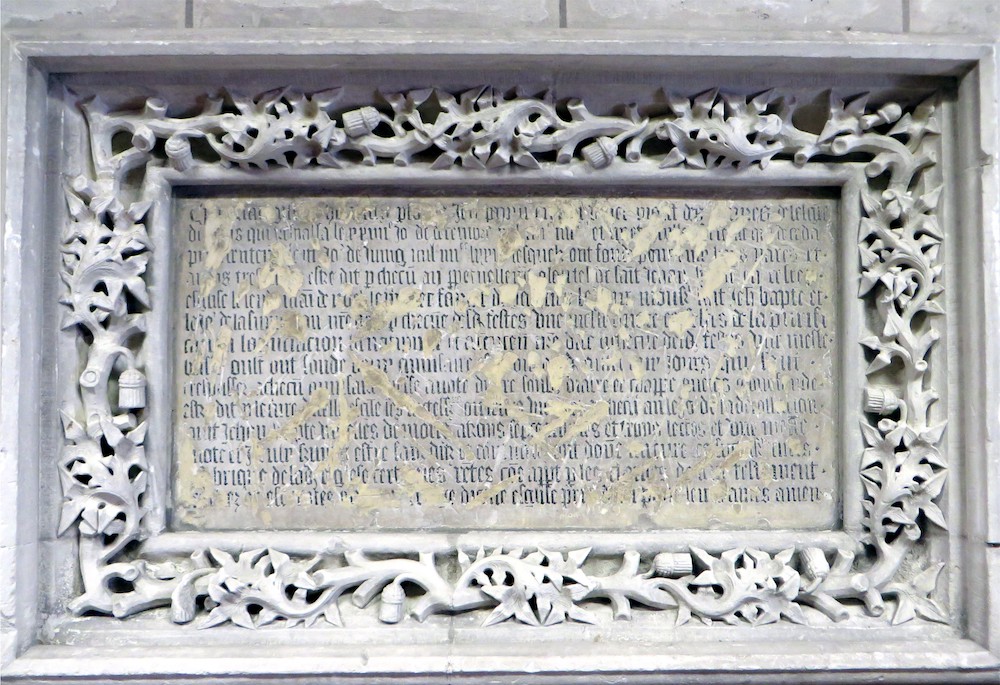 Jehan Papin inscription
At the opposite end of the same aisle, an inscription carved into the wall reminds us that Jehan Papin and his wife were buried here. The name of Jehan Papin remains linked to that of Saint-Gatien Cathedral in Tours, where he was one of the master builders in the 15th century, notably for the construction of the north tower.
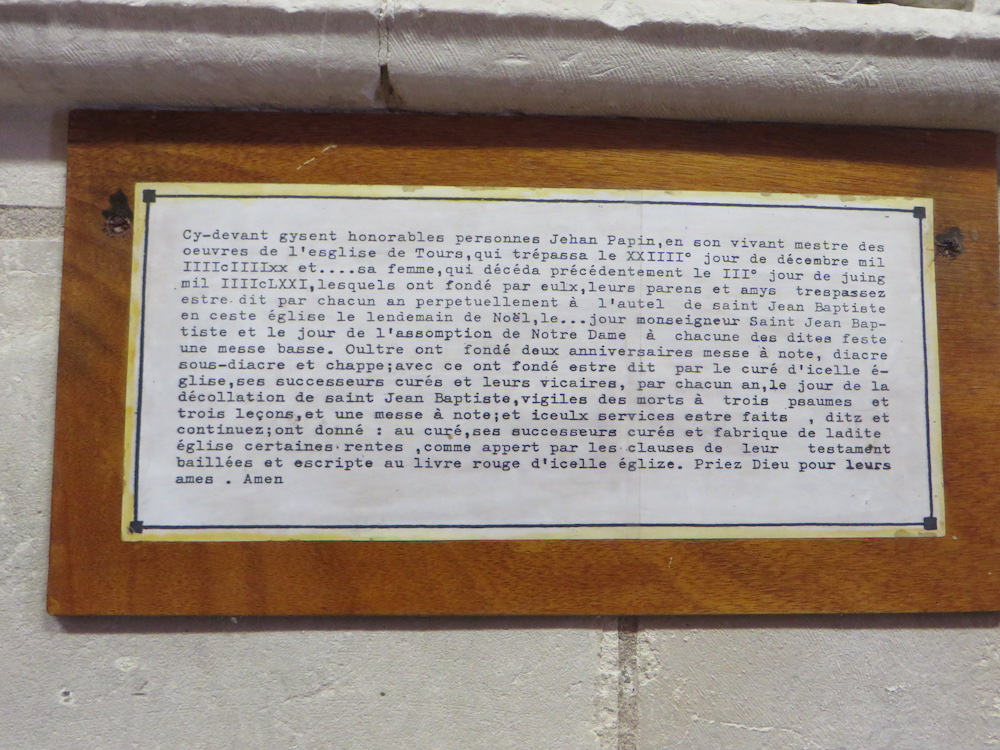 Jehan Papin inscription
Walking back up the north aisle, the eye is drawn to a wall monument dedicated to the Sacred Heart (1945) and, further on, a statue of Saint Nicholas dating from the 17th century. The tub holding the children was added later and the colouring was done in the 19th century. We can therefore deduce that it was at that time that the attribution to “Saint Nicholas” was logically adopted.
Finally, the altar dedicated to Saint Joseph, like the one dedicated to the Virgin Mary, is the work of Gustave Guérin.
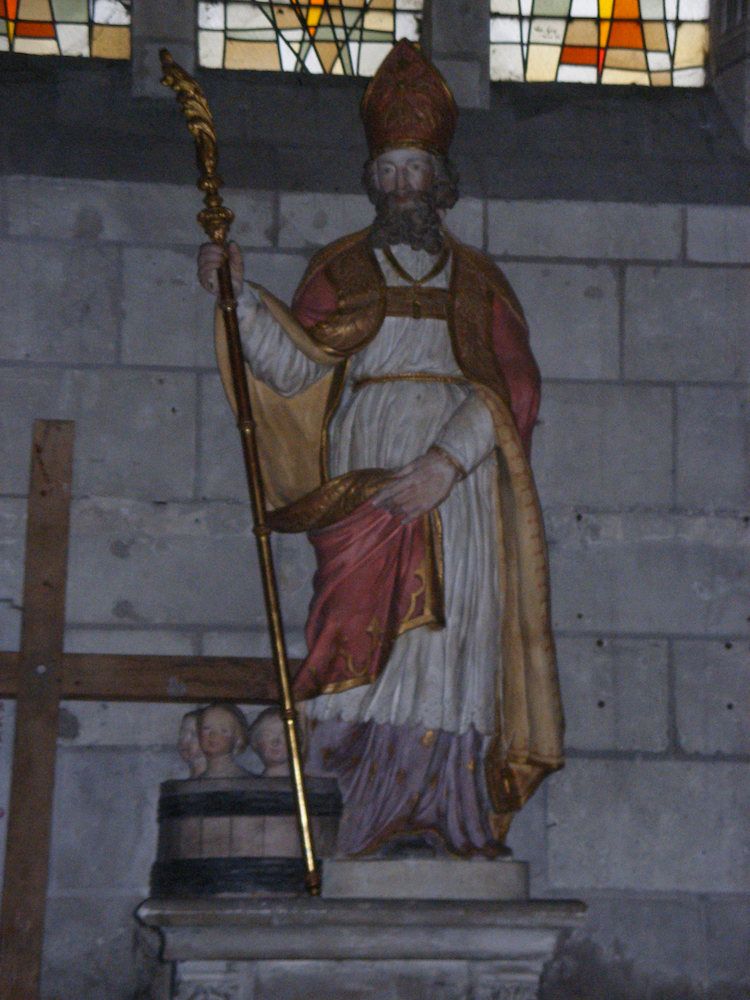 Saint Nicholas
The particular affection one may feel for the Saint-Pierre-Ville church also shows through its stained-glass windows, another story of family and neighbourhood!
When Father Plailly was parish priest of Saint-Pierre-Ville, from 1837 to 1857, he decided to give “his church” new windows. A great art lover and a practitioner himself, he also took part in surveying and decorating other churches in Touraine (Saint-Julien...). But to carry out his plans for Saint-Pierre-Ville, he began by going to the Manufacture Royale de Sèvres in Choisy-le-Roi (1840) to seek advice from Gustave Bontemps. As soon as he returned, he set to work. Once the first cartoons were finished, they had to be made, and for that a kiln was essential. This is where another local figure comes in: Charles-Jean Avisseau, who lived very close by, on place Saint-Pierre.
Charles-Jean Avisseau, a ceramist, had rediscovered Bernard Palissy’s enamelled ceramic technique. Thanks to the help he gave in building the kiln, our parish priest was able to fire his stained-glass.
1846 is a landmark year: Father Plailly’s first window was put in place. It is at the end of the south aisle, near the altar dedicated to Mary. It depicts the Annunciation and John the Baptist. It is divided into three lancets: the Virgin occupies the central one, with the Angel Gabriel to her left and Saint John the Baptist to her right. Both in the choice of colours and in the composition, the result is quite creditable.
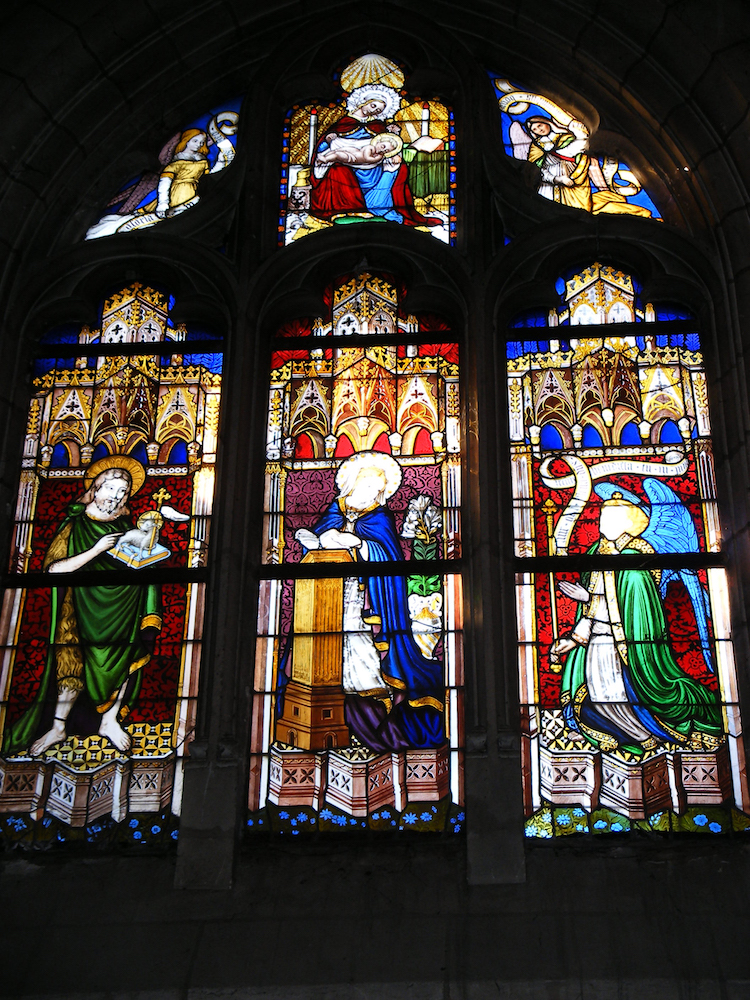 Annunciation
And our priest carried on with his task: Saint Nicholas of Bari at the bottom of the north aisle; then he dedicated the second window, further up the same aisle, to Saint Anthony, Saint Fiacre and Saint Isidore. The figures themselves are rather clumsy and the sense of proportion somewhat approximate, but the interest of these three lancets lies in each of the “miniature pictures” that accompany them. Each in its own way, they show a page from the life of these “patron saints”: craftsmen such as copyists and bookbinders, gardeners and ploughmen.
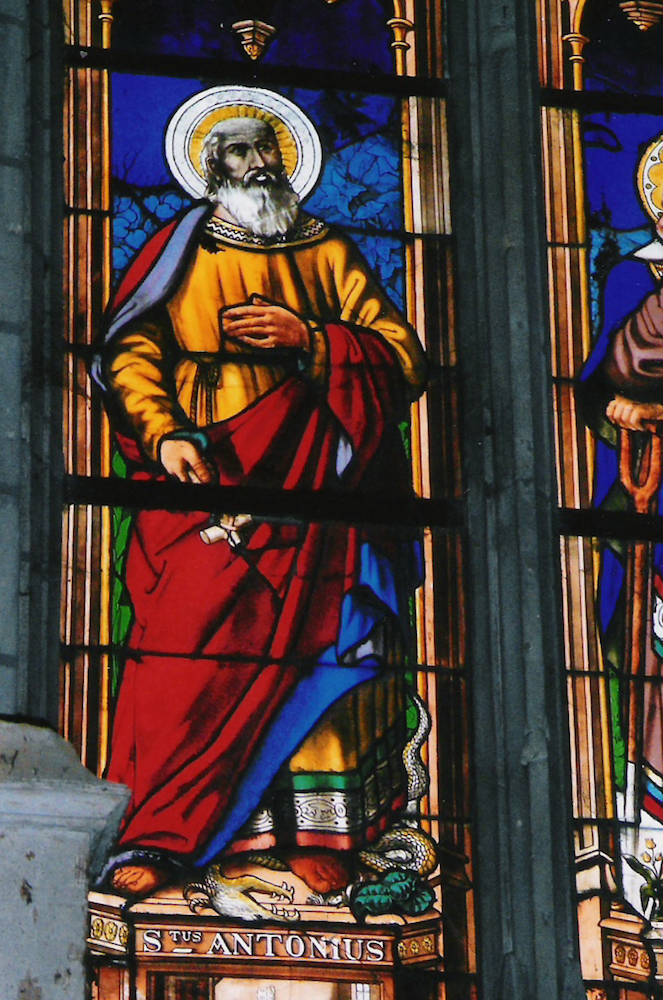 Saint Anthony
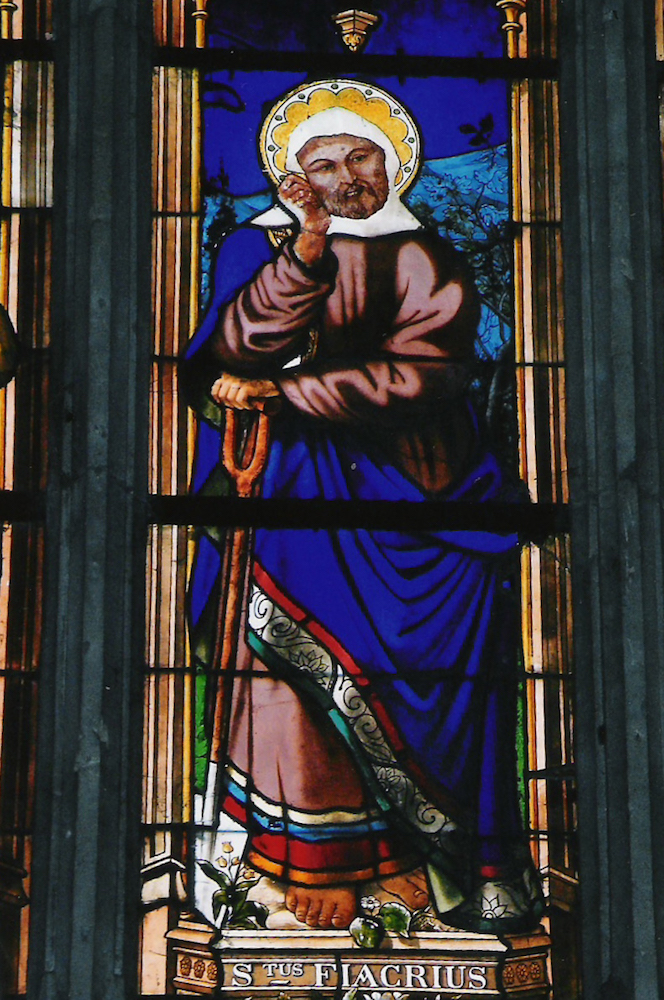 Saint Fiacre
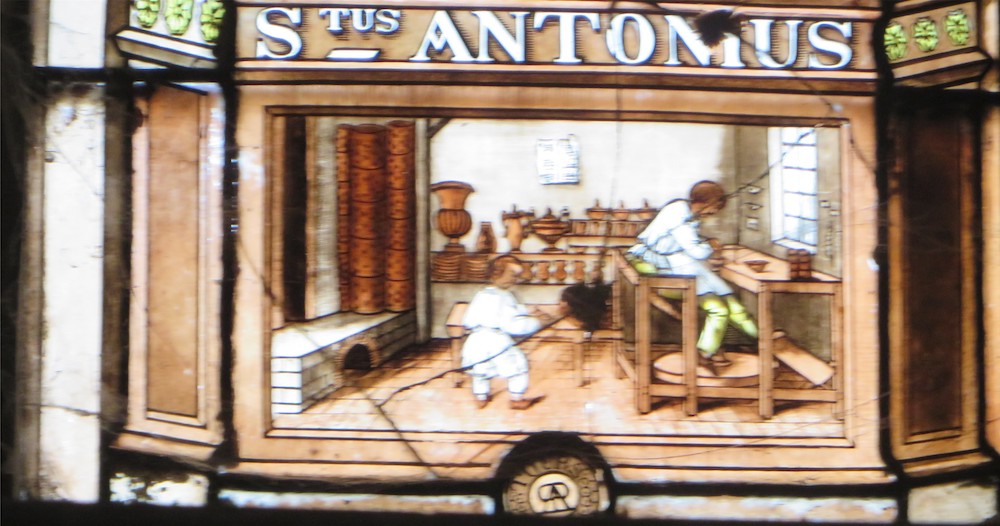 Saint Anthony cartouche (copyists)
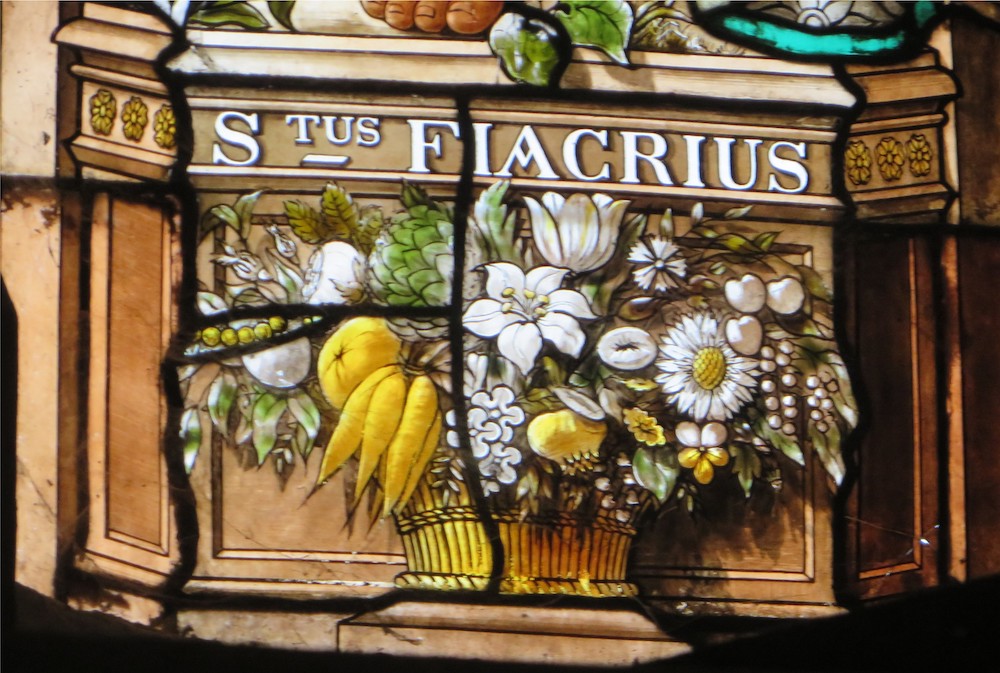 Saint Fiacre cartouche (gardeners)
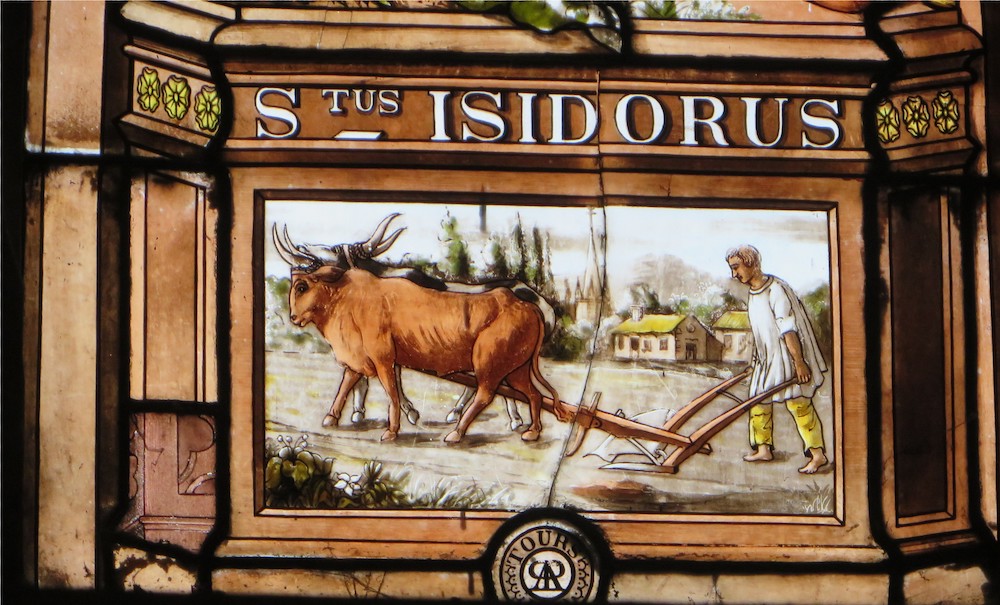 Saint Isidore cartouche (ploughmen)
Let us not forget here the church’s original setting, in the “varennes” (riverside farmland) of Saint-Pierre-des-Corps, nor the craftsmen who later came to settle along the Grand’rue (today’s rue Blanqui) and well beyond. It was each one of them that Father Plailly wished to welcome into “his church”. All of them were thus truly invited and recognised there.
To continue his work, the following year (1847) the parish priest decided to found a stained-glass manufactory. Among his partners was a young painter he had met, a friend of Gustave Guérin, specialising in religious painting, winner of the Prix de Rome and freshly awarded the Gold Medal of the Artistes Français: Julien-Léopold Lobin.
He began by making cartoons for Father Plailly, but very soon took over the management of the stained-glass manufactory and settled in the neighbourhood. For Saint-Pierre-Ville, he made his first windows:
- In the south aisle: the Raising of Lazarus, the Theological Virtues and a grisaille window.
- In the north aisle: the Presentation in the Temple.
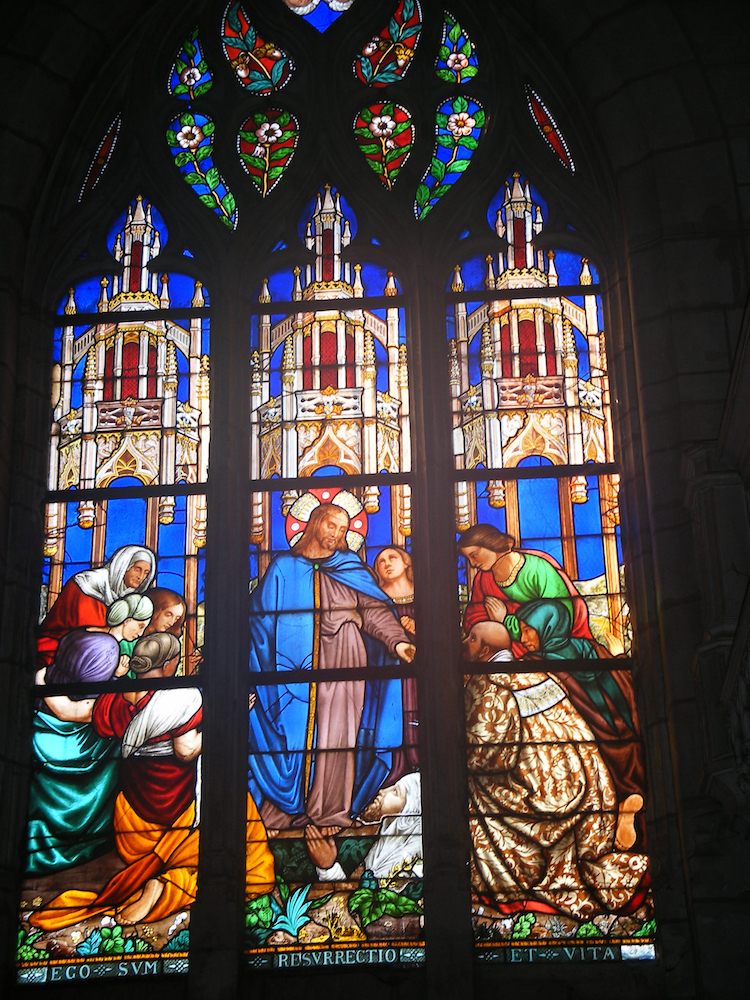 Raising of Lazarus
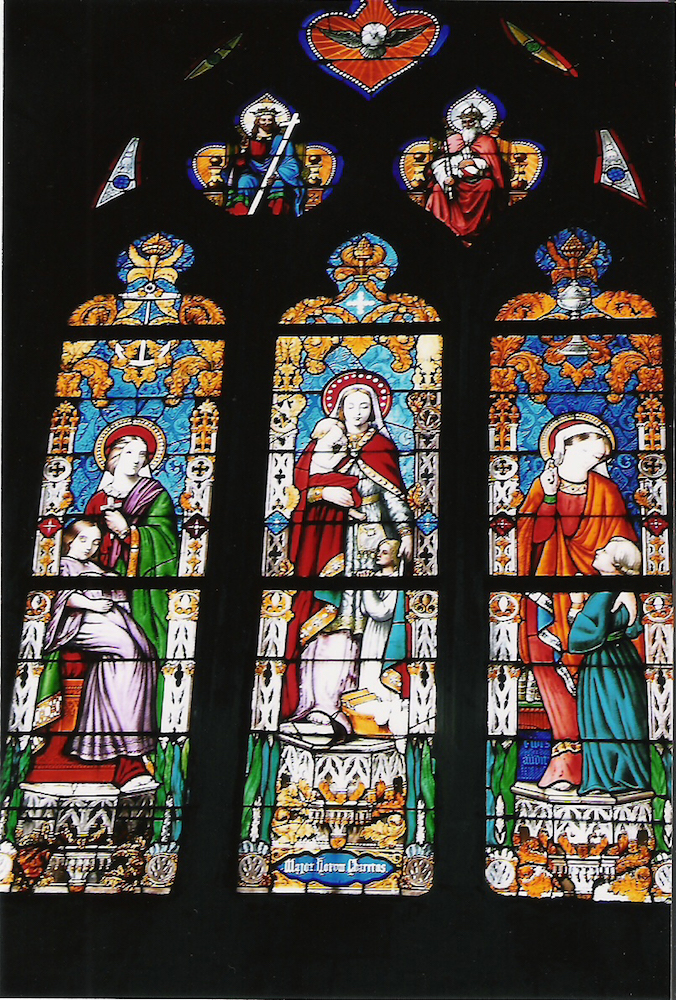 The Theological Virtues
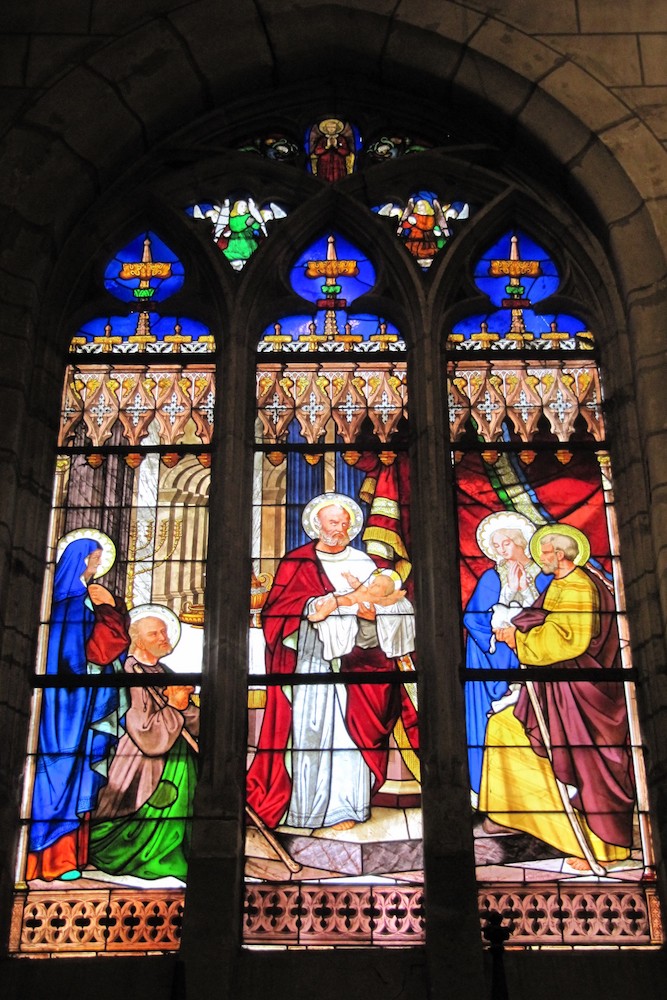 The Presentation in the Temple
The conclusion is simple: Julien-Léopold Lobin, influenced by his training as a painter, had a very clear aim: to turn the stained-glass window into a true “picture window”. The Raising of Lazarus and the Presentation in the Temple are good examples. The scenes unfold across three lancets, each complementing its neighbour like the pieces of a jigsaw puzzle.
So the way was opened here, at Saint-Pierre-Ville, for this kind of work, which would make the Lobin workshop famous not only in Tours and Touraine but throughout western France.
On the death of Julien-Léopold (1864), his son Lucien Léopold took over. We owe him the windows of the choir. This time the scenes are stacked vertically:
- On the north side, episodes from the life of Saint Peter.
- On the south side, the Conversion of Saint Paul.
- In the centre, the Adoration of the Shepherds, which catches the eye from the far end of the nave.
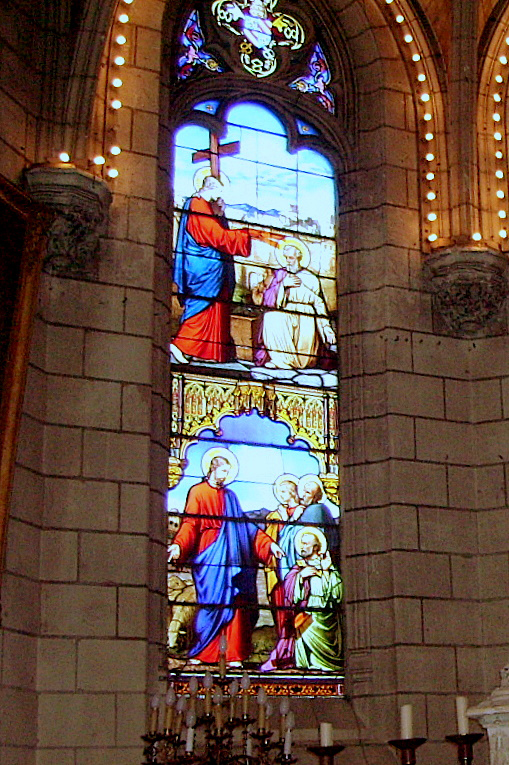 Saint Peter
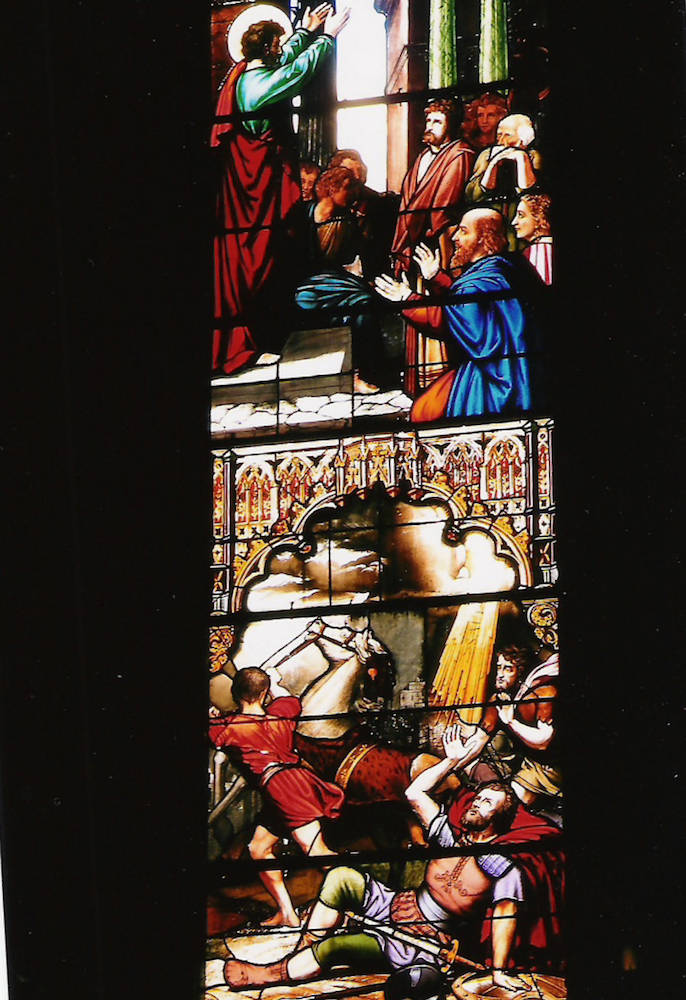 Saint Paul
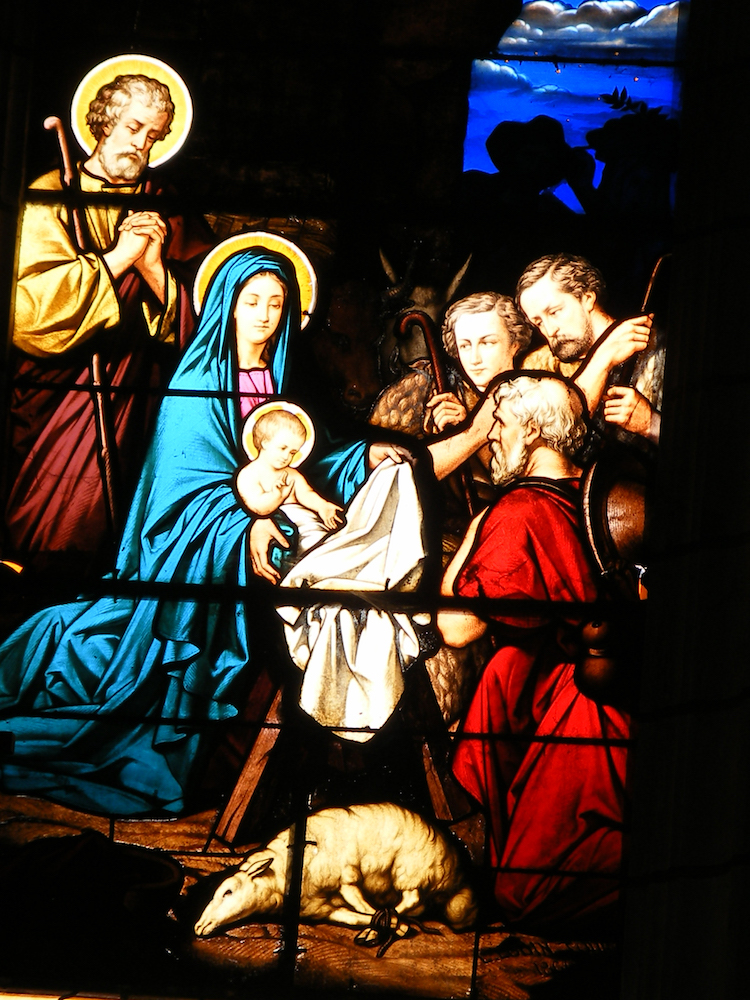 The Adoration of the Shepherds
Here it takes on a very special meaning. A tribute from Lucien-Léopold, it is a true family portrait: the two shepherds in the background are given the features of Julien-Léopold, his father, and of Marcel Léopold, his brother, who died aged 20 in Rome while they were completing their training as painters together. Finally, in the upper part, among the adoring angels, the one on the right holding the scroll shows us Cécile, Lucien’s younger sister.
So here, summed up in “our church”, is the story of the stained-glass windows of Saint-Pierre-Ville.
But the story does not end there, for one cannot pass over in silence, or fail to stop before, the high altar. It brings to mind the Avisseau family. Charles-Jean, with the valuable help of Father Plailly in building his stained-glass kiln, had rediscovered Bernard Palissy’s enamels; his son Joseph-Édouard, who succeeded him, went on to apply and develop this art to decorate the altar of Saint-Pierre-Ville, as well as that of the chapel of the Dominicaines de la Présentation (Dominican Sisters of the Presentation) at La Grande Bretèche.
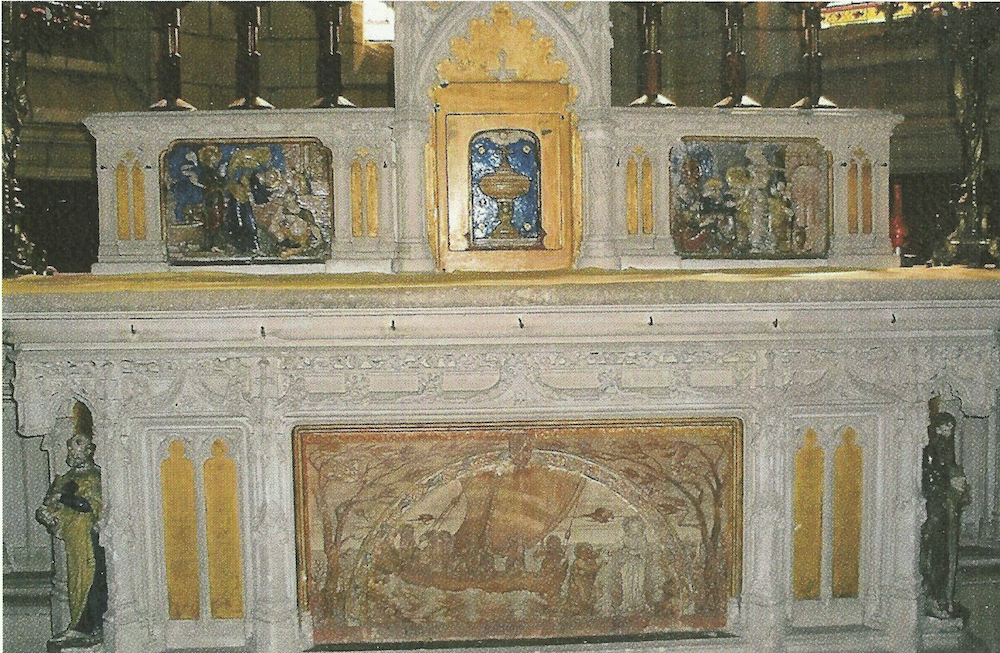 The altar
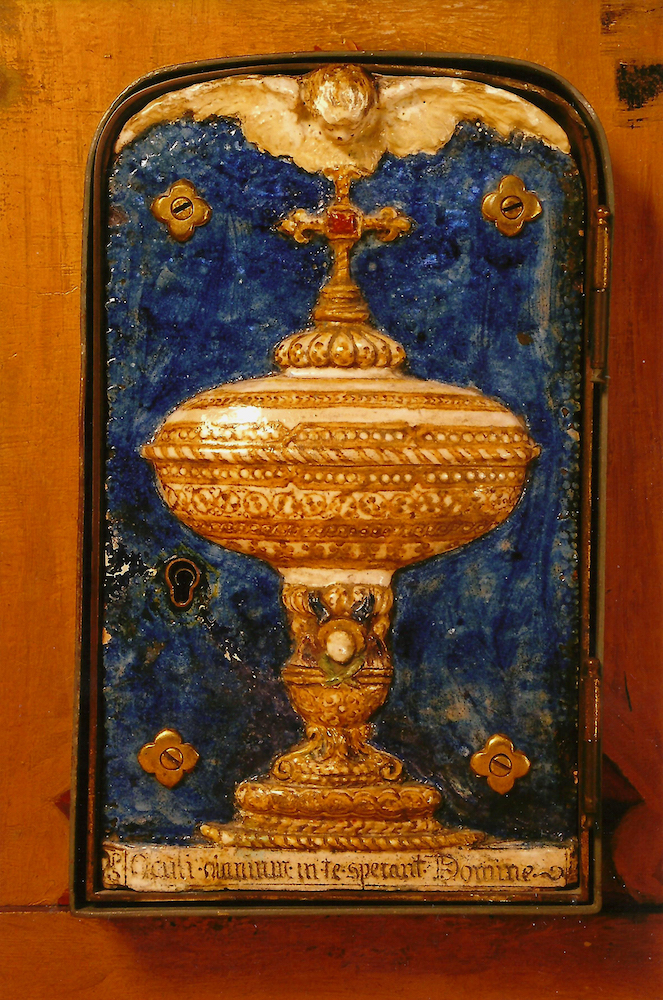 Tabernacle door
The tabernacle door is adorned with a ciborium in high relief. On either side, also in high relief, are, on the left, the healing of a cripple at the Beautiful Gate and, on the right, the deliverance of Saint Peter by an angel, a tribute to the saint chosen as the church’s patron.
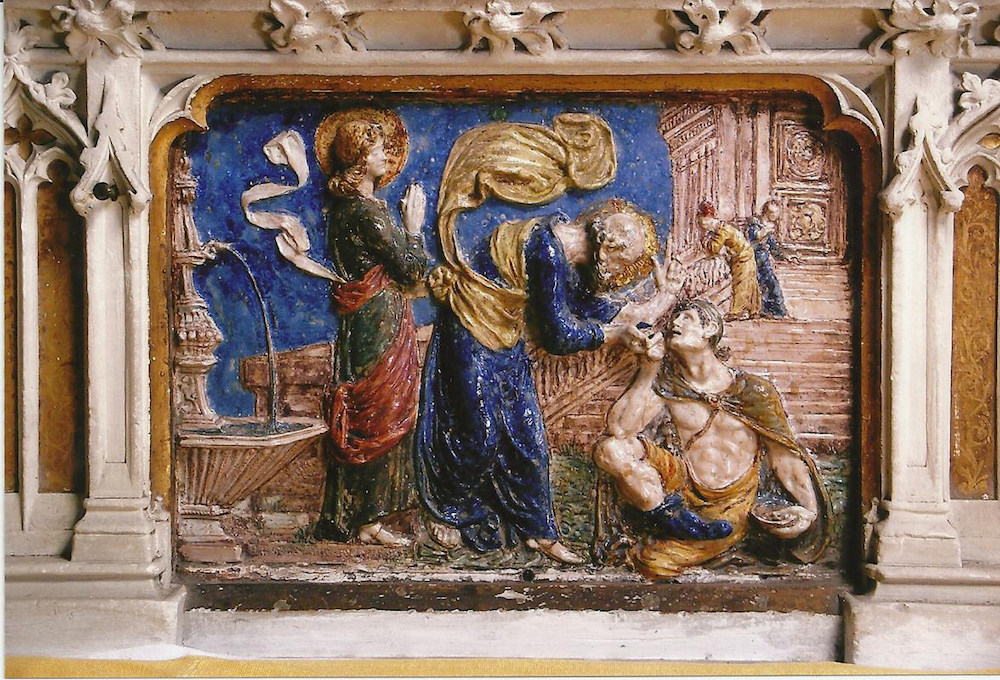 Healing of a cripple at the Beautiful Gate
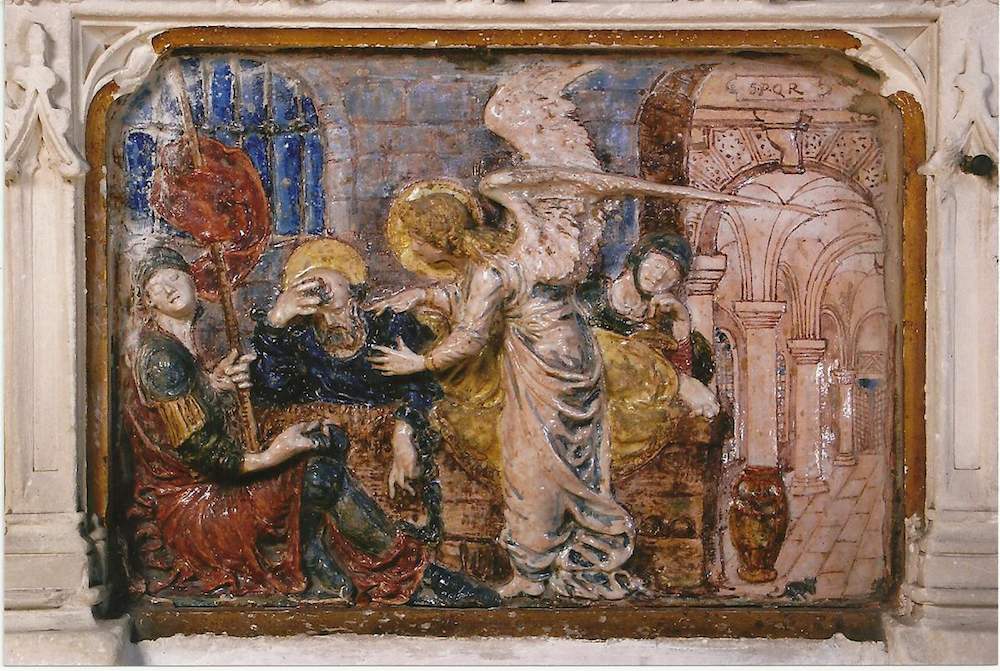 Deliverance of Saint Peter by an angel
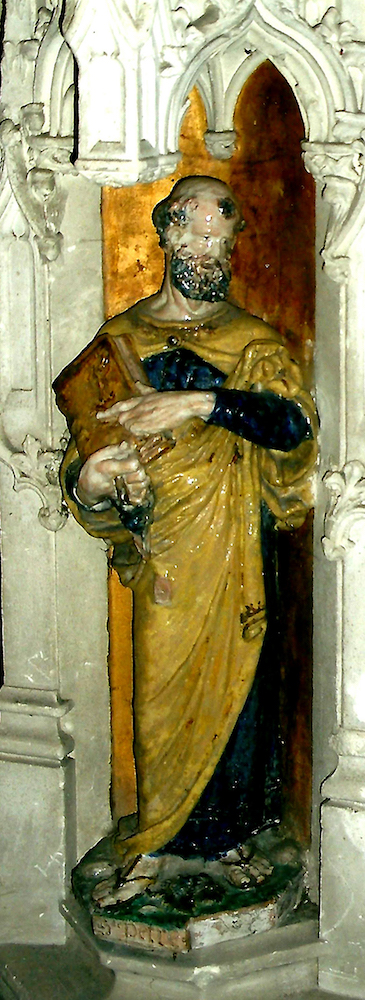 Saint Peter
The front of the altar is treated differently: it is framed by two statues in enamelled earthenware, depicting Saint Peter and Saint Paul.
In the centre, a panel shows Jesus walking on the water. Joseph-Édouard treated it like a Renaissance red-chalk drawing. Clays of different shades, from dark brown to white, inlaid or applied, bring out every detail of the scene.
The chosen theme is also a perfect invitation to faith, one call among many suggested throughout the church.
And so the message of the altar, of the windows and even of the architecture comes across: the story of a religious family, the story of an earthly family, the story of a neighbourhood, the story of a family of artists. Such is the richness of the Saint-Pierre-Ville church.
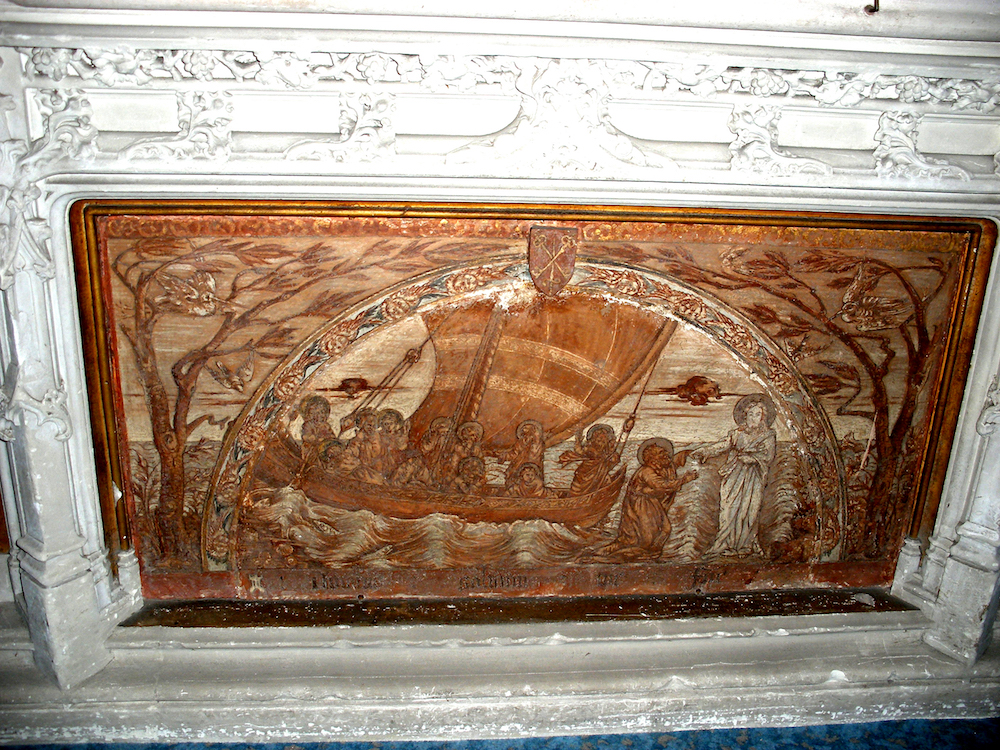 Jesus walking on the water
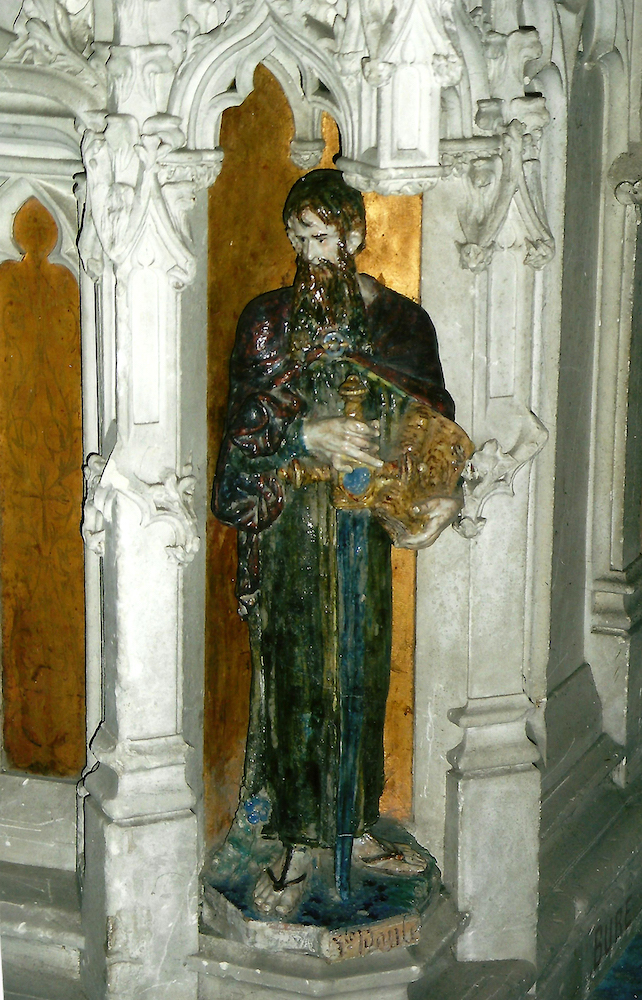 Saint Paul
Marie-Laure Barcat