Saint-Julien Church
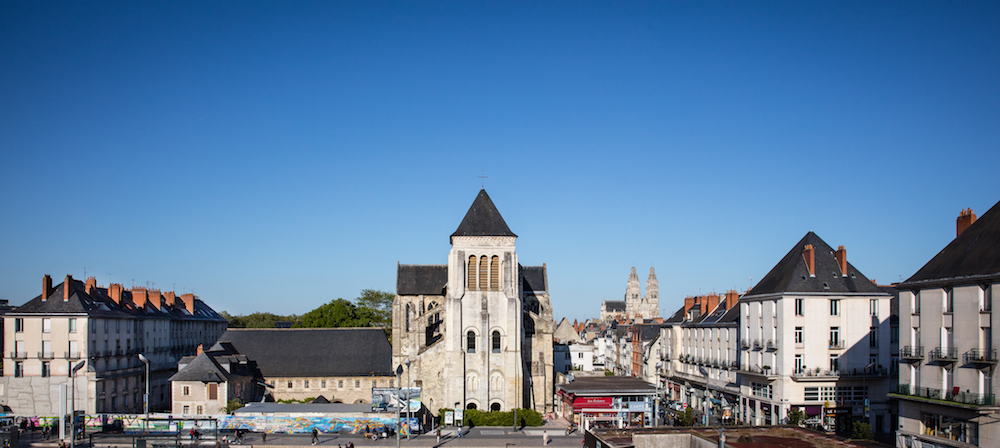
Did you know that this church once belonged to an abbey?
At the end of the 6th century, Gregory of Tours (Bishop of Tours) brought relics from Brioude, including a fragment of the veil that covered the
tomb
of Saint Julian; a few monks from the Auvergne came with him and brought the Rule of Saint Benedict. A genuine abbey was born, which became very
prosperous in the Carolingian period. The chapter house and the square plan of a cloister bear witness to this. The presence of Saint Julian’s relics
explains its name.
The abbey stands between the two centres that made up medieval Tours: the bishop’s city around the cathedral, and Châteauneuf, home to
the Basilica of Saint Martin.
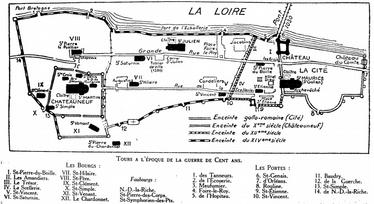
In the 13th century, as everywhere in Europe, Tours became more urban, its two centres grew denser and convents of the mendicant orders settled there: the Jacobins (Dominicans) and the Cordeliers (Franciscans). Side streets off rue Colbert bearing these names mark where they stood.
A little history
In abbeys, it is the Rule of Saint Benedict (6th century) that is followed. The monks commit themselves to contemplation and remain within the walls
of their monastery: the Rule values a balanced life built around prayer and work. Marmoutier was also
a Benedictine abbey. The Dominicans and Franciscans (13th century), on the contrary, sought to be present in the
city. The Dominicans, known as the Order of Preachers, set out to evangelise and teach. Following the example of their founder, Francis of Assisi, who sought
a life of poverty, the Franciscans evangelise, and their simple way of life is one means of doing so.
Who are the main historical figures?
- Saint Julian (3rd century). Like Martin, he was a soldier in the imperial army. Jacobus de Voragine relates that when the governor Crispinus sent one of his men to kill him, Julian came out of his house of his own accord and offered himself as a martyr. His head was then brought to Saint Ferreolus, who was threatened with the same fate if he did not sacrifice to the gods. He refused and was executed. His body and the head of Saint Julian were placed in the same tomb. In the 11th century, Julian’s relics were brought to the abbey.
- Saint Gregory of Tours (538-594): Bishop of Tours in 573, he is a major figure in the city’s history. Besides his duties as bishop, he is remembered as the author of a life of Saint Martin, of the “History of the Franks” (an ecclesiastical history) and of a “treatise on the life and miracles of Saint Julian”. It is worth noting that he was a deacon at the Basilica of Saint-Julien in Brioude.
- Theotolo: Bishop of Tours in 940, he had the Saint-Julien church rebuilt after the Norman invasions.
- Odo of Cluny (882-942): he came from a leading family of the Tours region. At 18 he was a canon of the Basilica of Saint Martin. In 927 he became Abbot (head) of the famous Abbey of Cluny. He died in Tours in 942; his tomb and that of Theotolo were in the abbey church of Saint-Julien.
A little history
Odo was behind the growth and reform of Cluny, which spread across Europe. This is known as the monastic renewal. From then on
the abbey came under the authority of the Pope, thus freeing itself from lay or episcopal control, more interested in the wealth of the place than
in its spiritual purpose. Many abbeys followed the Cluniac model, such as Saint-Julien and Marmoutier in Tours. But two centuries
later, Cluny had become a wealthy abbey and its influence waned. Once again, reform was needed. Saint Bruno and
Saint Bernard of Clairvaux restructured the Benedictine Rule by creating the Carthusian (Grande Chartreuse) and Cistercian (Cîteaux) rules,
which called for very great austerity. They still exist today.
Have you ever seen a porch tower?
The church is made up of two parts, which correspond to its periods of construction
- The porch tower, in its final form, dates from the end of the 11th century. It illustrates the Romanesque period. The 11th century bears witness to the abbey’s influence in spiritual, intellectual and artistic matters. In 1007 the abbey acquired many relics, including the head of Saint Julian and a sandal of Our Lord discovered in a reliquary; this stirred devotion and drew many pilgrims. Miracles multiplied and pilgrimages abounded. The abbey prospered. Abbots Richer and then Gerbert were behind the works and the building of the Romanesque church.
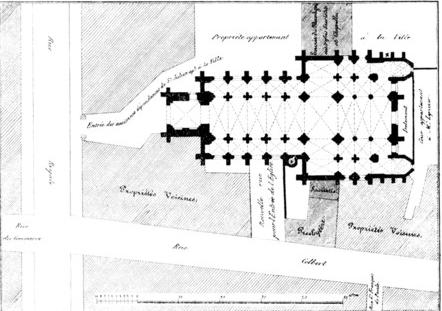
- The nave, in a sober Gothic style, was built after the building was destroyed by a hurricane. The flat east end remains a puzzle, as it is unusual. The Notre-Dame-la-Riche church in Tours has the same distinctive feature. We also know that the east ends of Cistercian abbey churches are flat.
The iconography: 11th-century frescoes and contemporary stained-glass
The frescoes are on the first floor. They tell of the crossing of the Red Sea described in the Book of Exodus, which belongs to a group of books, the Pentateuch (the written Torah for Jews), which is the foundation of faith for Jews and Christians.
Why is there contemporary stained-glass in the choir and the apses?
The windows from the 1950s replaced the Lobin windows, which were destroyed during the Second World War.
- In the apses, the windows by Le Chevalier depict, on the north side, the tetramorph, that is to say the four evangelists: the lion of Saint Mark, the ox of Saint Luke, the eagle of Saint John and the man of Saint Matthew. On the south side, they depict prophets.
- In the centre, the window by Max Ingrand evokes the Book of Genesis, which, like Exodus, belongs to the Pentateuch.